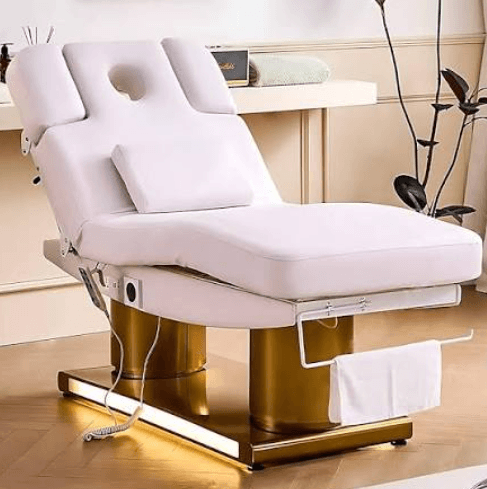
Adjustable esthetician beds represent critical investment in supporting technician health, comfort, and service quality. Unlike fixed-position beds, adjustable options enable customization accommodating diverse technician heights, client sizes, and service requirements. Understanding adjustment capabilities and ergonomic benefits helps evaluate whether adjustable investment aligns with your facility vision.
Height Adjustment Range and Technician Accommodation
Quality adjustable beds provide height ranges accommodating diverse technician heights and preferences. Typical adjustment ranges of 8-14 inches enable proper ergonomic positioning for technicians from approximately 5’0″ to 6’4″. Wide adjustment ranges ensure comfortable working positions throughout staff diversity.
Recline Angle Customization and Service Flexibility
Adjustable recline angles accommodate different service types and client preferences. Some services benefit from nearly flat positioning, others from seated positions. Customizable recline angles enable service flexibility without requiring multiple equipment types.
Weight Capacity and Stability Considerations
Adjustable beds must maintain stability throughout adjustment ranges and accommodate diverse client weights. Quality construction ensures adjustable esthetician beds structural integrity regardless of adjustment position or client size. Stability provides confidence in equipment reliability and safety.
Smooth Operation and Adjustment Responsiveness
Quality adjustable mechanisms provide smooth, responsive operation without jerking or grinding. Smooth adjustment maintains client comfort and enables precise positioning throughout service. Responsive controls support technician efficiency and client satisfaction.
Programmable Position Memory
Advanced adjustable beds include position memory enabling technicians to save preferred configurations. One-touch positioning to memorized heights streamlines workflow and ensures consistent positioning for specific services. Position memory demonstrates design sophistication supporting operational efficiency.
Load-Bearing Capacity and Weight Distribution
Adjustable mechanisms must reliably support client weight throughout adjustment ranges. Quality construction ensures even weight distribution preventing tilting or instability. Proper load capacity supports diverse clientele accommodation.
Lock and Stability Features During Service
Quality adjustable beds include locks or stability mechanisms preventing unintended movement during service delivery. Secure positioning maintains client confidence and enables technician focus on service delivery. Stability features represent essential safety consideration.
Maintenance and Adjustment Mechanism Care
Adjustable mechanisms require periodic inspection and maintenance ensuring smooth operation and reliability. Understanding maintenance requirements before purchasing ensures appropriate care and support. Preventive maintenance extends equipment life.
Noise Level During Adjustment
Quality adjustable systems operate quietly, maintaining peaceful service environments. Noisy adjustment mechanisms disrupt relaxation and detract from premium experiences. Quiet operation supports professional atmosphere and client satisfaction.
Backup and Manual Operation Capability
Consider adjustable systems including manual backup operation enabling continued function during rare motor failures. Manual backup ensures service continuation even if electrical systems malfunction. Backup capability provides operational reliability assurance.
Detailed specifications document adjustment ranges, weight capacities, and mechanical capabilities. Professional recommendations highlight which adjustment features provide genuine operational value. Hands-on evaluation of adjustment mechanisms helps assess quality and responsiveness.
FAQs
What adjustment range should I look for in esthetician beds?
Adjustment ranges of 8-14 inches typically accommodate diverse technician heights and service requirements. Verify that specific ranges match your staff heights and service needs.
How often do adjustable mechanisms require maintenance?
Quality systems require inspection and basic maintenance every 6-12 months. Professional servicing every 2-3 years maintains optimal performance and prevents gradual mechanism wear.
Can I adjust esthetician beds during service or only between clients?
Quality beds support smooth adjustment throughout service when needed. Avoid frequent repositioning during active work, but smooth adjustment capability enables client-specific customization as needed.
See aslo: How a Market Research Platform Helps Businesses Make Data-Driven Decisions
Conclusion
Adjustable esthetician beds represent important investment in technician health, service quality, and operational flexibility. By selecting beds offering appropriate adjustment ranges, smooth mechanisms, and reliable stability, you create work environments supporting professional excellence. Investment in adjustable technology demonstrates commitment to technician wellness and service quality, supporting staff retention and client satisfaction.